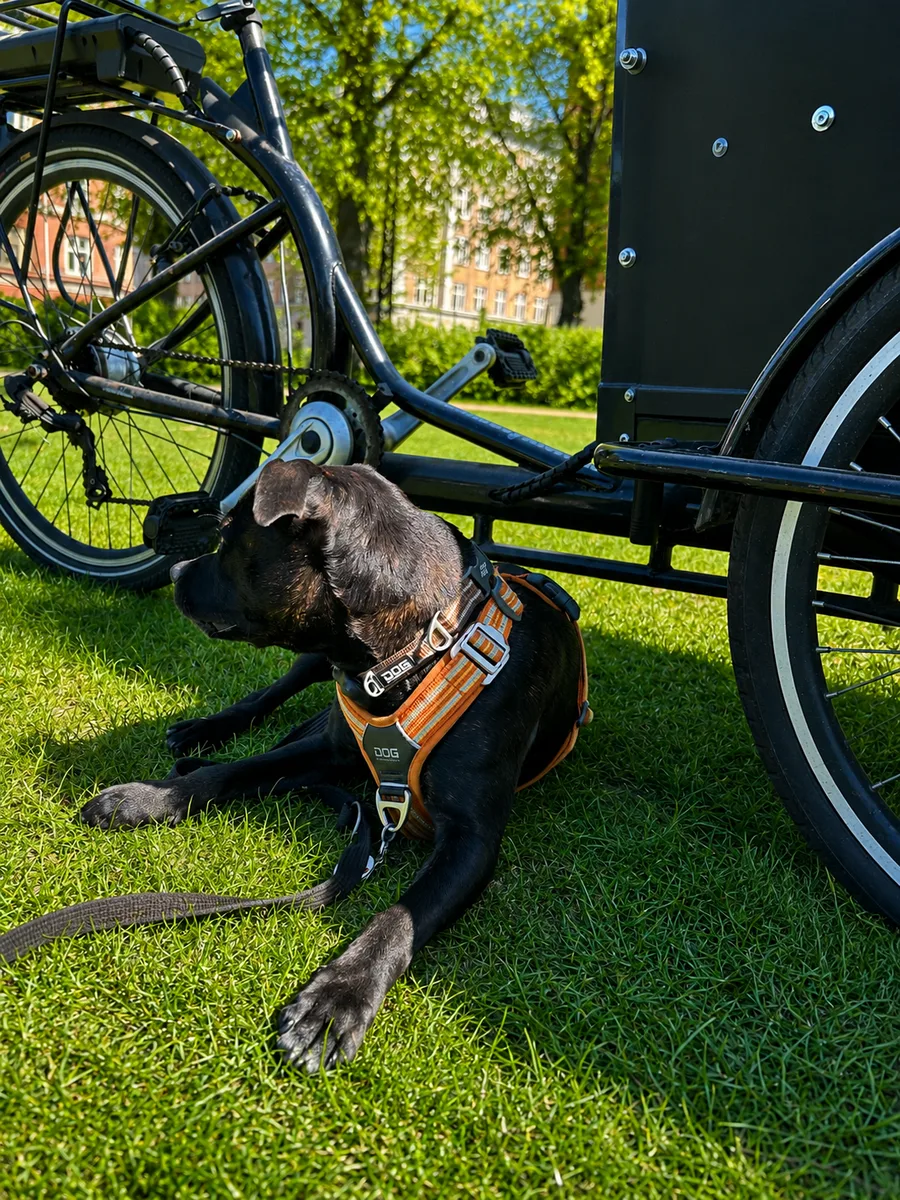
Agnes hates being left at home. When I decided to commute and run errands by bike instead of by car, the question was never whether she'd come along — but how. A cargo bike with a door she could walk in through? A low box? Three wheels, so it keeps its balance when she shifts around? I had no idea. And apparently, neither did the internet.
Four weeks, twelve tabs and zero answers
I did what everyone does: googled "best cargo bike for dogs". What I found was ad-stuffed pages without data, retailers keen to sell exactly what they had in stock, and "top 10" lists clearly written from press releases by people who had never stood with a dog and a tape measure in front of a cargo box.
Nobody could tell me the simple things: How wide is the box inside? Is there a door? How much can it carry? What does it cost today — not list price, but actually? The numbers existed, but they were scattered across a hundred product pages in a hundred different formats. Comparing just two bikes honestly took a spreadsheet and a whole evening.
Why it ended up being me
I'm a trained computer scientist (Danish: datamatiker) and currently study IT security. My whole day job is taking messy, scattered information and turning it into something structured you can trust — and staying healthily sceptical of numbers I haven't verified myself. So when I hit this problem, it was honestly a fun challenge: build one honest database where every bike is broken down into the same fields, so two models can be placed side by side on equal terms. And once it existed for me, it might as well help everyone else stuck in the same place.
So I built what I was missing
elbike.dk is that spreadsheet, grown into a real database. Every single bike is broken down into the same fields — motor, torque, battery, dimensions, box size, load capacity, room for kids (and dogs) — so models can be compared honestly and directly. Right now it covers 402 models from 61 brands, with 334 verified current prices read from the retailers' own pages. Those numbers update automatically every time the database grows — so what you're reading is always the current count.
The most important principle is also the simplest: we'd rather show a gap than a guess. If I can't confirm a figure from a real source, it says "–". No invented specifications, no fabricated reviews, no "test winner" claims I can't stand behind. That's the whole point — a database is only worth using if you can trust every single number in it.
How I keep it honest
- Independent. No retailer or manufacturer can pay for a better position. The sorting is pure data — lowest weight, biggest battery, cheapest price.
- Open about money. When you click an "Ad link" and buy, I may earn a commission — the price is the same for you. It affects neither the data nor the order, and the database also includes bikes and shops I don't earn a krone on.
- Sources, not promises. If I reference a test, I name who made it. Read it all on the methodology page.
And Agnes?
She got her spot — in a three-wheeled cargo bike with a door she sprints through the moment the harness comes out. Finding it took me four weeks. With this database, it takes you a few minutes. That was the whole idea.
Facing the same challenge? Start here: the best cargo bikes for dogs. And if you find an error or an outdated number, write to me — I'll fix it quickly, with thanks.